

LingGuang has emerged as one of 2025’s most talked‑about AI phenomena in China, quickly moving from developer demo to mass cultural moment. Part technological breakthrough, part social media spectacle, LingGuang combines advances in multimodal generative models, localized language and cultural grounding, and viral UX patterns to reach millions of users in a matter of weeks. Its rise highlights the accelerating pace at which advanced AI moves from labs to daily life and the new sets of opportunities, conflicts and policy questions that follow.

What LingGuang Is (and Isn’t)?
LingGuang (灵光) is a full-modal general-purpose AI assistant launched on November 18, 2025. Unlike traditional text-only chatbots, it integrates language, imagery, audio, data, code generation, and real-time scene understanding into a single powerful interface. The system is designed to make complex tasks easier for everyday users by producing rich, interactive outputs including 3D models, videos, charts, animations, interactive maps, and user-generated mobile apps—based on natural language prompts.
– At its core, LingGuang is widely described as a multimodal generative AI platform optimized for Chinese language and culture. Users interact via text, voice and images; the system produces coherent responses, stylized media, and often short video or audio content ready for sharing.
– Unlike earlier models focused primarily on English or broadly global data, LingGuang emphasizes culturally grounded outputs: idioms, regional dialects, historical references, and locally relevant humor that resonate strongly with Chinese audiences.
– It’s not just a chatbot: LingGuang’s viral appeal has been driven by features that let everyday users create persona‑driven content (virtual influencers, comedic sketches), remix popular culture, and produce polished multimedia posts with minimal effort.
Ant Group positions LingGuang not just as a chatbot but as a personal AI developer and creative assistant capable of translating user intents into fully functional digital products.
Why It Went Viral:
From the moment it debuted, LingGuang generated extraordinary user interest:
– Over 1 million downloads within four days of launch.
– More than 2 million downloads within six days, a pace that eclipsed early adoption of major AI apps like OpenAI’s ChatGPT and Sora.
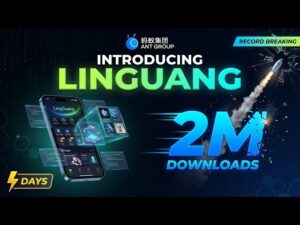
– Rapid ascent to the top of China’s App Store charts, including the #1 position in free tools.
– Viral UX: Templates for short video scripts, catchy audio snippets, and “persona filters” let even novice users produce polished content that performs well on platforms like Douyin and Kuaishou.
– Native cultural fluency: Outputs that understand and play with local memes, festivals, regional slang and pop culture are more engaging than generic, internationally trained models.
– Low barrier to entry: Lightweight mobile clients and integrated in‑app monetization or tipping enabled rapid distribution and an economic incentive for creators to adopt LingGuang.
– Network effects: Early adopters, influencers and micro‑celebrity creators — amplified the platform. Once a few formats trended, replication across communities and cities followed rapidly.
This explosive growth reflects both the app’s functional appeal and China’s broader hunger for AI tools that are practical, engaging, and easy to use.
Technology and Design (high‑level):
– Multimodal backbone: LingGuang likely rests on a large multimodal model trained on text, audio, and video frames, tuned with instruction‑style fine‑tuning and reinforcement learning from human feedback (RLHF) focused on Chinese data.
– Modular inference: To serve many mobile users with low latency, LingGuang probably uses a hybrid architecture: cloud servers for heavier generative tasks and lightweight on‑device models for personalization and local safety filters.
– Persona and style control: The system offers controllable generation users can specify tone, era, dialect or a public persona template, enabling consistent, brandable outputs.
– Safety and alignment tooling: Given regulatory and reputational risk, LingGuang integrates content filters, provenance labels for AI‑generated media, and attribution options for creators though the effectiveness of such measures is a live debate.
Social and Cultural Impact:
– Democratized creative production: By lowering technical barriers, LingGuang has allowed a broader slice of the population to produce high‑quality creative content, accelerating the creator economy and spawning new microgenres.
– Virtual influencers and performance art: AI personas developed with LingGuang have become fixtures on livestreams and short video platforms, raising questions about authenticity, labor displacement in entertainment, and how fandom operates.
– Language and cultural effects: The model’s success underscores the demand for AI that “speaks like us.” But reliance on learned cultural patterns can also propagate stereotypes or ossify certain portrayals if not carefully managed.
Commercial Opportunities:
– Creator tools and commerce: Companies are integrating LingGuang into tools for scriptwriting, product descriptions, ad creative, and livestream prompts increasing efficiency for e‑commerce and marketing teams.
– Licensing and enterprise APIs: Enterprises may license LingGuang for customer service, inbound content generation, and internal knowledge synthesis particularly where localized language competence is essential.
– Platform dynamics: App developers and content platforms could monetize add‑ons, premium persona templates, or verification services to certify human‑AI collaborations.
Regulatory and Ethical Concerns:
– Mis/disinformation and synthetic media: The ability to generate convincing audio and video raises risks of deepfakes, political misinformation, and scams. Regulators and platforms face pressure to require provenance metadata and rapid takedown processes.
– Copyright and data provenance: Questions about the datasets used to train LingGuang whether copyrighted media or proprietary cultural content were included and how creators are compensated are central to emerging legal scrutiny.
– Labor and creative attribution: As AI takes on roles in content creation, disputes may arise over authorship, monetization, and whether human creators who post AI‑assisted work should disclose that assistance.
– Privacy and surveillance: If LingGuang’s training or personalization relies on user uploads (images, voice), safeguards are needed to prevent misuse, reidentification, or unintended data exposure.
Responses from Stakeholders:
– Platforms and creators: Many platforms have embraced LingGuang for engagement metrics, while some creators leverage it as a productivity boost; others worry about content saturation and erosion of distinct creative voices.
– Regulators and civil society: Officials have signaled interest in clarifying rules around AI‑generated content, digital identity, and platform responsibilities. Civil society groups call for transparency measures and stronger consumer protections.
– Companies and competitors: Competing AI firms are racing to match LingGuang’s localization strengths, pushing further specialization (regional dialect models, industry‑specific assistants).
Open Questions and What to Watch:
– Accuracy vs. virality: Can LingGuang balance entertaining outputs with factual accuracy, especially in news, health, and finance domains?
– Monetization and creator rights: Will new revenue‑sharing models emerge to compensate human creators whose styles inform AI outputs?
– Oversight and labeling: Will regulators require clear, consistent labels for AI‑generated media and standardized provenance metadata?
– International reach: Will LingGuang remain focused on the domestic market, or will variants and translations expand its footprint abroad and with what safeguards?
Summary:
LingGuang’s viral ascent is emblematic of the current AI moment: rapid technical capability gains, explosive cultural adoption, and a rush to figure out governance after the fact. Its combination of deep linguistic and cultural fluency with accessible creative tools shows how localized AI products can outperform generic global models in engagement but also illustrates the cascade of ethical, legal and social questions that follow. Observers should watch how platforms, creators, regulators and competitors respond: those reactions will shape whether LingGuang becomes a sustainable innovation in creative technology or a flashpoint that accelerates tighter rules around generative AI.
Follow us for updated news, articles, and videos. Read more on http://www.dawentsit.com/ #Technology #DawentsIT #TechnologyNews #Tech #LingGuang #AI #Multimodal #UX #AntGroup #AllThingsTechnologyNews #AllThingsTechnologyNewsToday #WeInspireToDeliver


I’ll definitely come back and read more of your content.