
Hey, Tech enthusiasts! Your Daily Dose Of Tech This Thursday is here @DawentsIT …We Inspire To Deliver!
Your Daily Dose Of Technology News – October 01, 2026.
1. OpenAI Pushes Further Into Autonomous AI Agents With Dots:
OpenAI is also pushing aggressively into agentic AI following its DevDay 2026 announcements. OpenAI introduced Dots, described as always-on AI agents capable of taking responsibility for ongoing work rather than simply responding to individual prompts.
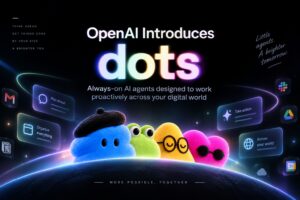
A Dot can be given a goal, connected to relevant applications and allowed to continue working between conversations.
Examples discussed by OpenAI include:
* Software testing
* Website development
* Research
* Planning
* Email campaigns
* Business analysis
* Other extended professional tasks
OpenAI describes Dots as a major step beyond conventional AI assistants because the system can continue making progress after the initial interaction.
According to OpenAI’s release information, Dots are powered by GPT-6 Astra and use their own cloud computer.
The rollout is currently limited to eligible users and markets, with enterprise access initially offered as a beta.
The interesting development isn’t simply Dots itself. OpenAI is entering an increasingly crowded AI-agent market, competing with products from Meta and Google that are also attempting to move AI from “answering” to “doing.”
Reports say that OpenAI is positioning Dots as a more professional and controlled alternative while Meta’s Muse emphasizes broad consumer accessibility.
In Other News:
2. Microsoft Wants Copilot To Become An “OS for work”:
Microsoft is also changing the role of its AI assistant. Microsoft’s redesigned Copilot is being positioned as a central workplace platform rather than simply an AI chatbot embedded inside Office applications.
The new strategy brings together:
– Home for general work
– Code for software development
– Autopilot for AI agents
– Microsoft 365/Office capabilities
– Enterprise workflows
– AI-powered application development
Microsoft’s goal is effectively to make Copilot the place where employees ask for work, create things, write software and delegate tasks to AI agents.
Microsoft CEO Satya Nadella has reportedly described this broader vision as an “OS for work.”
Microsoft already controls many of the applications businesses use every day, including Word, Excel, Outlook, Teams and other Microsoft 365 services.
If Copilot becomes the interface through which employees interact with all of those applications, Microsoft could shift the traditional workplace software model from:
– Application = User = Task
to:
– User = AI agent = Applications = Completed task
That is one of the biggest changes happening in enterprise software right now.
3. Google Launches Gemini 4 Argon, Its New Frontier AI Model:
Google has officially announced Gemini 4 Argon, a new frontier AI model focused less on ordinary chatbot interactions and more on complex, long-running professional tasks. Google says Argon is designed for software engineering, legal and financial knowledge work, and cybersecurity.
What makes Argon notable?: Google has significantly increased the model’s ability to work through lengthy tasks. Argon has a 1-million-token output limit, compared with 64,000 tokens for the previous generation cited by Google. That gives it considerably more room to reason through large projects in a single workflow.
Google says Argon is already being used internally for tasks including:

* Software engineering
* Large-scale code migrations
* Algorithm optimisation
* Financial research
* Legal workflows
* Cybersecurity
* Data-center optimisation
One example Google highlighted involves Argon analysing data center telemetry and identifying memory optimisations that could eventually free hundreds of terabytes of memory. Google also says Argon agents have been involved in migrating large C/C++ codebases toward Rust.
Google says Argon can find, validate and patch software vulnerabilities autonomously.
The company says the model discovered a critical vulnerability exposing sensitive personal information in healthcare software used by hospitals worldwide, something previous frontier models had failed to identify.
Because of the model’s capabilities, Google isn’t immediately opening it to everyone. Initial access is being provided through the Fairwind Program to trusted cybersecurity defenders, with broader access planned after additional testing and safety work.
Google says introductory API pricing will be $2 per million input tokens and $10 per million output tokens.
4. Micron Reports Enormous Demand For AI Memory:
The AI boom isn’t only benefiting companies building GPUs and AI models. Micron Technology has provided another major indication that demand for AI infrastructure remains extremely strong.
Micron reported a significantly stronger-than-expected revenue outlook and said customer commitments under long-term supply agreements had risen to $32 billion, up from $22 billion in June.
Micron is particularly important because AI accelerators require huge amounts of high-bandwidth memory (HBM). The company expects first quarter revenue of approximately $61.5 billion, according to Reuters, above analysts’ expectations of about $57 billion.
Micron also reported that remaining performance obligations increased to approximately $150 billion, compared with $100 billion the previous quarter.
The AI infrastructure buildout is extending beyond GPUs.
The supply chain increasingly includes:
AI models = GPUs = HBM = networking = servers = data centers = electricity
Demand for each component is becoming interconnected. That’s why Micron’s results are being watched as another indicator of the scale of the AI infrastructure boom.
5. Anthropic Expands Its Enterprise Footprint With Barclays:
Anthropic also announced today that Barclays is expanding its use of Claude across the bank. Barclays plans to use Claude for software development, modernisation of legacy systems and operational work. The bank expects Claude Code adoption to reach 50% of its developer population by the end of 2026, with a majority of software engineers potentially using it in 2027.
The announcement illustrates another emerging trend: large companies aren’t simply experimenting with AI assistants anymore. They’re beginning to integrate them into software development operations and core business workflows.
Odds And Ends:
6. Anthropic Expands Claude Into Government:
Anthropic has made Claude for Government generally available to U.S. federal and state agencies. The platform operates in a FedRAMP High authorised environment, allowing government organisations to use Claude’s coding and agentic capabilities under government security and compliance requirements.
Claude for Government can be used for tasks such as:
– Drafting government documents
– Reviewing RFPs
– Casework
– Coding
– Modernising government software
– Working with files
– AI-assisted research
Anthropic is also making Claude Code CLI and Claude for Microsoft 365 available through early access programs.
This represents another major shift: frontier AI companies are increasingly selling not just chatbots, but AI infrastructure for institutions.
7. Reddit Moves To Restrict Access Because Of AI Bots:
Reddit is tightening access to its platform. The company announced that it is ending RSS feeds and public API access, citing the increasing impact of AI bots and automated scraping.
This is part of a much bigger battle over internet content.
AI companies need enormous amounts of text and user generated material to train and operate AI systems. Meanwhile, websites hosting that content increasingly want:
– Compensation
– Greater control over data
– Restrictions on automated scraping
– Protection against unauthorised AI training
– More control over how their content is accessed
Reddit’s decision demonstrates how the AI boom is changing the underlying economics of the web.
8. SpaceX Starship Reaches Orbit For The First Time:
One of the biggest non AI technology stories today is SpaceX’s Starship test flight. SpaceX’s enormous Starship rocket reached orbit for the first time on September 28, according to reporting from the Associated Press and Los Angeles Times.
The vehicle is attempting a much more ambitious flight than previous Starship tests.
The mission includes deployment of 26 next generation Starlink satellites. The spacecraft is intended to remain in orbit for multiple passes before eventually completing a controlled Pacific Ocean splashdown.
One engine shut down earlier than expected during the flight, but flight controllers continued the mission after determining that the vehicle could proceed safely.
Starship is central to SpaceX’s long-term plans for:
* Moon missions
* Mars missions
* Very large satellite deployments
* Starlink expansion
* Heavy cargo transportation
* NASA’s Artemis program
The vehicle is also designed to be reusable, which could dramatically change the economics of launching very large payloads if SpaceX succeeds in making the system reliable.
Today’s flight therefore represents an important step in the development of the world’s largest reusable launch system.
9. AI Computing Is Moving Into Space:
One of today’s more unusual technology stories comes from Satlyt, a startup developing software designed to run AI workloads directly on satellites.
The company has raised $8 million in seed funding. Satlyt isn’t trying to build its own satellite fleet.
Instead, it wants to create software that lets satellites from different companies run AI workloads and potentially share computing resources.
The company’s software has already been tested in orbit.
Satlyt says an earlier deployment of Google’s Gemma model reduced the amount of data that needed to be transmitted to Earth by more than 60% when processing satellite software error information.

Normally, satellites collect data and send it to Earth for processing.
That creates problems:
– Limited bandwidth
– Communication delays
– High transmission costs
– Huge quantities of raw sensor data
If AI can process information directly in orbit, a satellite could determine what information is important before sending it to Earth.
Satlyt’s longer-term ambition is to create a shared computing network across multiple satellites.
For Summaries Or Deep-Dives On Any Tech Trends, Contact Us At DawentsIT Or Visit Www.Dawentsit.Com. Subscribe To DawentsIT For More Tech News And Videos. Stay Inspired, And We Deliver! Read more on http://www.dawentsit.com/blog-2/ #Technology #DawentsIT #TechnologyNews #Tech #OpenAI #AIAgents #Dots #Microsoft #Google #DailyDoseOfTech #AllThingsTechnologyNews #WeInspireToDeliver


