

Hey, Tech enthusiast! Your Daily Dose of Tech This Tuesday is here @DawentsIT …We Inspire To Deliver!
Your Daily Dose Of Technology News – March 17, 2026.
1. The Rise of Autonomous AI Agents:
AI agents capable of completing tasks autonomously are becoming a major industry focus. New AI frameworks allow systems to execute complex workflows autonomously. Companies are building “agent ecosystems” around enterprise applications.
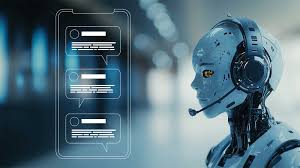
In China, Alibaba is restructuring its AI strategy and forming a Token Hub Business Group to develop AI assistant technologies and digital agents.
These assistants could handle tasks such as:
* Scheduling
* Email management
* Digital operations.
Meanwhile, analysts predict AI agents will soon automate large portions of government operations.
Forecast from Gartner says 80% of governments will deploy AI agents for routine decisions by 2028.
AI will also handle 50% of cybersecurity incident response operations.
AI is shifting from tools to autonomous digital workers.
In Other News:
2. Enterprise AI Platforms and Industry Automation:
Several companies announced new enterprise AI platforms today.
TCS enterprise AI platform: Tata Consultancy Services introduced Rapid Outcome AI, a platform built with NVIDIA infrastructure that helps organizations deploy AI solutions across business processes.
AI in logistics automation: DHL announced a major expansion of robotics automation using SVT Robotics’ SOFTBOT platform.
Key benefits:
* Robotics integration 12× faster than traditional custom software.
* Easier scaling across warehouses worldwide.
Large enterprises are rapidly moving from AI experiments to full operational deployment.
3. AI Expanding Into Smart Cities and Infrastructure:
AI adoption is also spreading into urban infrastructure.
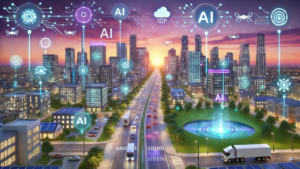
ASUS “AI City” initiative-
ASUS unveiled a concept platform for AI-driven smart cities, integrating systems for:
* Transportation
* Healthcare
* Public safety
* Sustainability monitoring.
These systems aim to create exportable smart-city models for governments worldwide.
4. Google Launches “AI Works for Europe”:
Google announced a training initiative designed to close the AI skills gap across Europe.
The program aims to:
* Train workers in AI tools.
* Prepare businesses for AI adoption.
* Accelerate Europe’s competitiveness in AI.
Global tech companies increasingly invest in AI workforce development to support adoption.
5. Quantum Computing Integrates With Classical AI Hardware:
A notable breakthrough today comes from Quantum Machines, which announced the Open Acceleration Stack.
The system integrates:
* Quantum processors (QPU)
* GPUs (NVIDIA)
* CPUs (AMD)
This architecture enables:
* Real-time quantum error correction.
* Hybrid AI-quantum computing workflows.
Low-latency links between quantum processors and classical accelerators allow much faster synchronization and computation. Quantum computing development is shifting from experimental systems to scalable hybrid computing architectures.
Odds And Ends:
6. New AI Platforms for Consumer and Automotive Devices:
Voice-AI company SoundHound AI introduced a multimodal on-device AI platform for vehicles.

Key capabilities:
* Multilingual voice assistants.
* Visual and voice input processing.
* Autonomous AI agents running locally on devices.
This reduces reliance on cloud connectivity and improves privacy and response speed.
7. Memory and Chipmakers Race to Supply AI Hardware:
The AI boom is driving intense competition among semiconductor companies.
Samsung’s HBM4E AI memory: Samsung revealed HBM4E high-bandwidth memory, designed to accelerate large AI workloads and improve integration with NVIDIA’s AI systems.
HBM (High Bandwidth Memory) is critical for:
* AI model training.
* Inference clusters.
* Supercomputing workloads.
AI datacenter power innovations
STMicroelectronics announced 800-volt power conversion systems for AI datacenters, improving energy efficiency and power delivery. AI data centers are becoming massive energy consumers, so power infrastructure innovation is now a key competitive area.
The entire semiconductor ecosystem from **memory chips to power electronics**is pivoting toward AI infrastructure.
8. NVIDIA’s AI Infrastructure Push Dominates Tech Headlines:
The biggest story today comes from announcements and discussions at NVIDIA’s GTC 2026 developer conference.
– NVIDIA unveiled a strategy focused heavily on AI inference computing, the phase where AI models generate responses or perform real-time tasks.
– CEO Jensen Huang estimated that the AI inference market could reach $1 trillion by 2027, roughly doubling earlier projections.
– The company introduced a new CPU architecture called “Vera” and advanced computing systems designed for large-scale AI deployments.
NVIDIA also teased its future “Feynman” chip architecture planned for 2028.
The industry is moving from:
* AI training (building models) to
* AI inference (serving billions of real-time requests).
Companies like OpenAI and Meta are scaling AI services to massive user bases, which dramatically increases demand for inference infrastructure.
Huang also emphasized that every company will soon require an “AI agent strategy”, referring to software agents capable of autonomous decision-making.
This shift means AI infrastructure and chips will remain the most valuable layer of the AI economy.
For Summaries Or Deep-Dives On Any Tech Trends, Contact Us At DawentsIT Or Visit Www.Dawentsit.Com. Subscribe To DawentsIT For More Tech News And Videos. Stay Inspired, And We Deliver! Read more on http://www.dawentsit.com/ #Technology #DawentsIT #TechnologyNews #Tech #AIAgents #AI #Alibaba #TCS #NVIDIA #AllThingsTechnologyNews #DailyDoseOfTech #WeInspireToDeliver


