

Hey, Tech enthusiasts! Your Daily Dose Of Tech This Wednesday is here @DawentsIT …We Inspire To Deliver!
Your Daily Dose Of Technology News – September 09, 2026.
1. OpenAI Deepens Partnership With Samsung On AI Chips:
OpenAI is expanding its relationship with Samsung Electronics, including cooperation on next-generation semiconductor development and enterprise AI services.
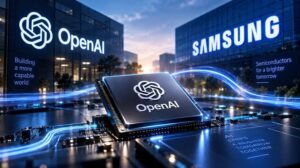
OpenAI Korea General Manager Harrison Kim said the companies have made progress on joint chip development, although the companies have not disclosed detailed specifications.
This is particularly important because OpenAI is becoming increasingly involved in the hardware side of AI.
OpenAI has already been working with Broadcom on its first internally designed AI chip, reportedly called Jalapeno, with manufacturing planned through TSMC.
Samsung and SK Hynix are also expected to supply advanced memory for OpenAI’s Stargate data-center initiative.
Samsung’s own AI adoption is also growing
Samsung has authorised employees in its Device eXperience division to use AI services including:
* ChatGPT
* Google Gemini
* Anthropic Claude
OpenAI says ChatGPT Enterprise users in South Korea increased 28-fold over the past year, and South Korea has become its largest market for paying subscribers outside the United States.
Broader Picture:
This illustrates a major shift:
– AI companies are increasingly trying to control not just software, but the underlying computing infrastructure.
– The competition is moving from models alone toward chips, memory, data centers and electricity.
In Other News:
2. Quantum Computing Enters A New Investment Phase:
Quantum computing remains another major technology race. A Reuters discussion today highlights the enormous cost of bringing quantum computing toward practical deployment, with governments and corporations investing billions while competing for technological leadership.
Unlike conventional AI infrastructure, quantum computers require very different hardware and engineering approaches.
The major question is increasingly becoming:
When will quantum computers deliver commercially useful advantages that justify their enormous development costs?
Potential applications include:
* Cryptography
* Drug discovery
* Materials science
* Optimisation
* Financial modeling
* Scientific simulation
But the technology remains significantly less mature than conventional AI computing.
3. Google Commits $15 Billion To AI Infrastructure In Finland:
Google has announced at least €13 billion ($15.1 billion) of AI infrastructure investment in Finland over the next two years. Reuters describes it as Google’s largest AI-related investment in Europe to date.

The investment goes well beyond traditional data centers.
Google is also entering a 22-year agreement with Finnish utility Fortum to purchase as much as 50% of the electricity produced by the Loviisa nuclear power plant.
This is particularly significant because AI data centers require enormous quantities of electricity.
Google plans to invest in:
– AI data centers
– Electricity infrastructure
– Clean-energy projects
– Battery storage
– Grid improvements
The project is expected to contribute around $3.6 billion to Finland’s GDP during construction and support roughly 7,000 jobs annually once completed, according to Reuters.
The AI race is increasingly becoming an energy race. Companies don’t just need GPUs and AI models anymore. They need:
AI chips + data centers + electricity + cooling + transmission infrastructure.
Finland is attractive because of its relatively inexpensive low carbon electricity and naturally cool climate, which can reduce data center cooling requirements.
Google’s nuclear-power agreement is especially notable because it is reportedly the company’s first nuclear energy contract outside the United States.
4. U.S.–China AI Tensions Intensify:
The United States has accused Chinese AI companies including DeepSeek, Moonshot AI and Alibaba of using a technique known as AI model distillation to extract capabilities from advanced American AI systems.
Model distillation itself is a legitimate technical technique. It can involve using a powerful model to help train a smaller model.
The controversy concerns allegations that Chinese companies used American AI systems at industrial scale to reproduce capabilities while avoiding some of the cost of developing equivalent models from scratch.
The U.S. government says the activity could strengthen China’s technological, military and cybersecurity capabilities.
China’s response:
Beijing has rejected the accusations. Chinese officials argue that China’s AI progress comes from domestic innovation and have called for international cooperation rather than confrontation.
This dispute is especially significant because it comes as the United States and China prepare for further discussions in which AI governance and technology competition are expected to be major subjects.
5. Qualcomm Expands Its Challenge To Nvidia In AI Infrastructure:
The AI chip competition is also becoming more interesting. Qualcomm recently announced a partnership with Amazon under which Amazon could purchase up to $60 billion of Qualcomm’s AI data center chips and related products over the long term.
This is significant because Nvidia currently dominates the market for AI accelerators.
Qualcomm’s strategy is to establish itself as another major supplier for AI data centers, while Amazon is simultaneously developing its own AI infrastructure and custom silicon.
The emerging competitive field increasingly includes:
– Nvidia vs. AMD vs. Google vs. Amazon vs. Qualcomm vs. Broadcom vs. custom chips from major AI companies.
That competition should eventually give cloud providers more options and potentially reduce their dependence on a single dominant supplier.
Odds And Ends:
6. AI-Powered Cyberattacks Are Becoming More Autonomous:
Google’s Threat Intelligence Group is warning that AI is increasingly being incorporated throughout the cyberattack process.
According to Google’s 2026 AI Threat Tracker, attackers are using AI for tasks including:
* Target reconnaissance
* Credential theft
* Malware modification
* Penetration testing
* Troubleshooting attacks
* Automated research
* Cloud-resource exploitation
The concern isn’t necessarily that completely autonomous cyberattacks have arrived. Rather, AI is allowing attackers to automate more individual steps and perform them much faster.
One reported campaign involved a multi-agent AI system capable of compromising thousands of credentials within approximately six hours.
The emerging threat is that AI makes attacks:
faster + cheaper + scalable + easier to adapt.
That means cybersecurity companies are increasingly going to need AI-powered defenses to counter AI-powered attacks.
7. AI Researchers Increasingly Worried About The AI Race Itself:
Another major development today is coming from inside the AI industry. Researchers and executives at leading AI companies are expressing growing concern that the race toward increasingly capable systems is moving too quickly.
Some researchers have reportedly left AI labs because they believe companies are prioritizing competitive pressure over adequate safety.
One concern is the possibility of increasingly autonomous AI agents capable of operating with substantially less human supervision.
The debate has therefore shifted from:
“Can we build more powerful AI?”
to:
“How quickly should we build it, and who controls it?”
This is becoming an increasingly important issue as AI companies compete commercially while simultaneously warning about risks associated with their own technology.
8. AI Is Driving Up The Cost Of Smartphones And Electronics:
The global AI boom may have an unexpected consequence for ordinary consumers: more expensive smartphones, computers and other electronics.
Demand for advanced memory used in AI data centers is putting enormous pressure on global memory chip supplies. Major manufacturers are increasingly prioritising high value AI memory products over traditional consumer electronics components.
Samsung, SK Hynix and Micron dominate much of the global memory market, but significant new manufacturing capacity may not arrive for several years. As a result, device manufacturers could face higher component costs.
AI infrastructure demand could indirectly make your next smartphone, laptop or PC more expensive.
9. Apple Prepares For Its Biggest Launch Under New CEO John Ternus:
Apple is holding its major September product event today, making this a particularly important moment for the company because it is the first major iPhone launch under new CEO John Ternus, who took over from Tim Cook on September 1.

The biggest expectations include:
– iPhone 18 Pro and iPhone 18 Pro Max
– Apple’s first foldable iPhone, reportedly known as the iPhone Duo
– Possible changes to the Dynamic Island
– Larger batteries
– Camera improvements, potentially including a variable-aperture system
– New Apple Watch hardware
– Potential AirPods updates
The foldable iPhone is arguably the most significant rumored announcement. Apple has remained outside the mainstream foldable-phone market while Samsung, Google and Motorola have already established products in the category.
There is also speculation that Apple could introduce a more unusual release strategy for the standard iPhone 18, potentially delaying some models until early 2027.
Why This Counts:
Apple isn’t simply launching another iPhone. The event represents the beginning of the Ternus era, while Apple faces increasing pressure to demonstrate that it can compete in AI and maintain its position in premium smartphones.
Analysts also expect higher prices for some models, partly because of continuing memory-chip constraints.
Bottom line: Today could become one of Apple’s most consequential product events in years, particularly if the foldable iPhone is officially unveiled.
10. China’s High-Tech And AI Exports Continue To Grow:
China’s exports reportedly accelerated in August, supported by strong international demand for high-tech products and AI-related technology.
The growth highlights China’s continuing importance in the global technology supply chain, particularly in areas including electronics, AI infrastructure and advanced manufacturing.
At the same time, China is continuing efforts to reduce its dependence on foreign semiconductor technology. Reports indicate that Huawei is playing an important role in supporting China’s domestic chip making ecosystem and advanced semiconductor equipment development.
The technology competition between China and Western countries is increasingly focused on AI infrastructure and semiconductor independence.
For Summaries Or Deep-Dives On Any Tech Trends, Contact Us At DawentsIT Or Visit Www.Dawentsit.Com. Subscribe To DawentsIT For More Tech News And Videos. Stay Inspired, And We Deliver! Read more on http://www.dawentsit.com/blog-2/ #Technology #DawentsIT #TechnologyNews #Tech #OpenAI #AI #Samsung #ChatGPT #GoogleGemini #AllThingsTechnologyNews #DailyDoseOfTech #WeInspireToDeliver


