

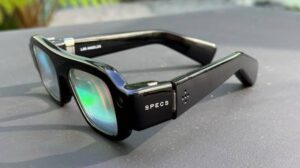
Snap has officially launched SPECS, its first fully standalone augmented reality glasses designed to function less like conventional smart glasses and more like a wearable computer. The commercial launch took place on September 16, 2026, in Los Angeles, following the product’s unveiling earlier this year.

A computer without a phone or headset: The key difference between SPECS and products such as camera-equipped smart glasses is that SPECS are intended to provide actual spatial computing directly in front of your eyes.
Snap describes them as a new category between conventional AI glasses and bulky VR/AR headsets. They operate independently, with no external computing puck or tether, while allowing digital information and interactive objects to appear over the real world.
Snap’s hardware includes:
* Two Snapdragon processors — one dedicated to computer vision and another for running AR Lenses.
* See-through AR displays with a 51-degree field of view.
* Up to 16 million colors.
* High-speed hand tracking.
* Spatial mapping and computer vision.
* Built-in speakers and microphones.
* Electrochromic lenses that can transition between clear and tinted.
* Prescription-lens support.
* Two frame sizes weighing approximately 132g and 136g.
Snap says the display can provide an experience comparable to a 24-inch desktop monitor for productivity or a much larger virtual cinema screen for entertainment.

SPECS Intelligence is a major part of the launch: Alongside the glasses, Snap introduced SPECS Intelligence, an AI service designed to work across SPECS, iPhone and Mac.
Rather than simply waiting for commands, Snap describes it as an anticipatory AI system intended to understand context and help with things such as work, travel, organisation and personal goals. An iOS preview is available, while Mac access initially uses an invitation based early access program.
This is important because Snap isn’t positioning SPECS simply as another pair of AI glasses. The company’s broader idea is that AI becomes an interface between the physical world and your digital information.
What can you actually do with them?:
Snap demonstrated a broad range of AR applications, including:
– Navigation: directions and contextual information can appear within your view instead of requiring you to constantly look down at a phone.
– Translation: SPECS can provide real-time language assistance while you’re interacting with the physical world.
– Shopping: products can be augmented with digital information and even 3D representations.
– Entertainment: users can interact with games, music and other AR experiences while remaining aware of their surroundings.
– Education: digital information can be overlaid onto physical objects and environments.
– Fitness and sports: Snap demonstrated AR experiences designed for training and interactive activities.
– Productivity: SPECS can function as a spatial workstation, allowing virtual computing environments to surround the user.
Snap is also targeting businesses: One of the more significant developments is Snap’s push into enterprise AR. The company has announced partnerships involving Salesforce, NVIDIA and Amazon Web Services, with applications aimed at areas such as manufacturing, retail and field services.
For example, workers could potentially access product information, inventory data, instructions or AI assistance without having to stop working and interact with a separate computer.
This gives SPECS a second potential market beyond consumers.
Price: $2,195
SPECS are launching at $2,195, with a $200 refundable deposit having been required for preorders. Snap is also offering a $2,395 package that includes a cellular-enabled charging case.
That makes SPECS substantially more expensive than mainstream AI glasses such as Meta’s Ray-Ban smart glasses, and puts them much closer to the pricing territory of premium computing hardware.
Cellular connectivity: Snap has also introduced a SPECS Charging Case with Cellular, allowing the glasses to have cellular connectivity through a dedicated case. A Verizon-related option is expected to cost $10 per month.
This potentially makes SPECS less dependent on having a smartphone nearby.
Privacy remains a major issue because SPECS have cameras and can understand their surroundings, privacy is an important part of the product.
Snap says SPECS do not use facial recognition and include a visible indicator when the camera is recording. The company is attempting to distinguish the glasses from surveillance-oriented devices by making recording activity apparent to people nearby.
Nevertheless, the combination of cameras, microphones, computer vision and AI processing means social norms around using AR glasses will likely remain an important issue.

The biggest challenge: size and practicality
The technology is ambitious, but early hands-on reports have identified some limitations.
The glasses are considerably bulkier than ordinary eyewear, and early testing has raised concerns about gesture recognition, visibility in bright environments and the relatively narrow 51-degree field of view.
At more than $2,000, consumers will also have to decide whether the AR functionality provides enough value to justify buying an entirely new computing platform.
Availability: Snap says SPECS are expected to ship in the United States, United Kingdom and France in fall 2026. In Los Angeles, consumers can get an in-person demonstration beginning October 1 at Westfield Century City through Snap’s SPECS First Look experience.
Why SPECS Counts:
SPECS represents a significant change in Snap’s ambitions. For years, Snap’s hardware strategy centered primarily around cameras and Snapchat. SPECS takes that idea much further: Snap is attempting to turn augmented reality glasses into a general purpose computer.
The company’s vision is essentially:
– Phone = screen you look at
– VR headset = computer that surrounds you
– SPECS = computer integrated into the world around you
Whether consumers will accept the relatively large design and $2,195 price remains an open question, but technically, SPECS is one of Snap’s biggest attempts yet to move computing away from traditional screens and into everyday physical environments.
For Summaries Or Deep-Dives On Any Tech Trends, Contact Us At DawentsIT Or Visit Www.Dawentsit.Com. Subscribe To DawentsIT For More Tech News And Videos. Stay Inspired, And We Deliver! Read more on http://www.dawentsit.com/blog-2/ #Technology #DawentsIT #TechnologyNews #Tech #SPECS #Snap #ARGlasses #NVIDIA #AWS #AllThingsTechnologyNews #TechNewsUpdate #WeInspireToDeliver


